
Donors and alliance members meet to find solutions to the challenges of funding TSÉ – A Look Back at the 6th TEC Collective Day
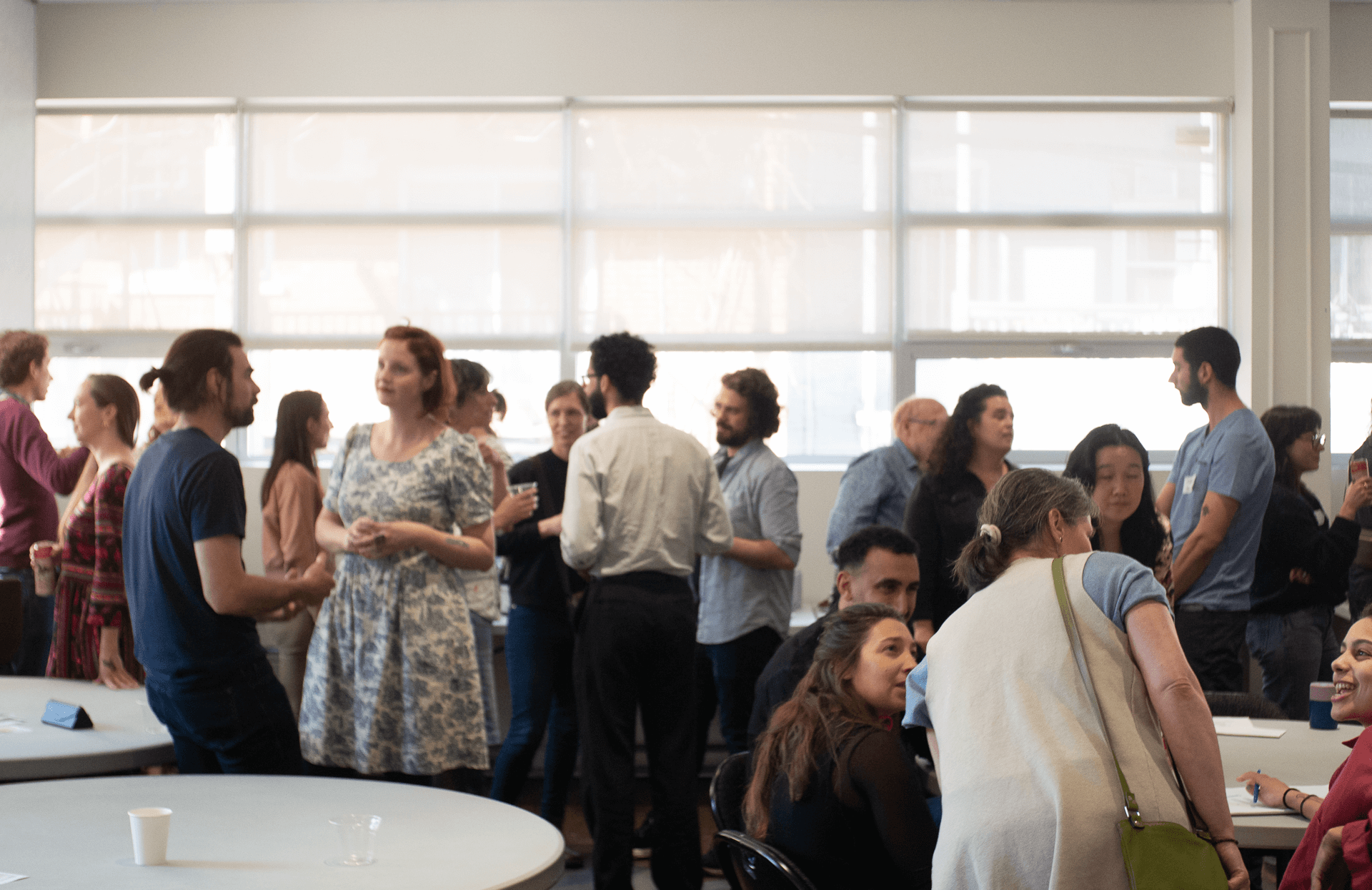
In a rare opportunity for dialogue and collaboration between funders and organizations committed to the socio-ecological transition in Montreal, the event’s participants gathered to take stock of the ecosystem’s funding situation and identify concrete solutions to address increasingly pressing needs. A snapshot of a day marked by active listening, great clarity, and a fierce determination to take action.
Last March, it was reported that Solon, an organization recognized as a leading player in TSÉ in Montreal, would be closing its doors due to a lack of funding. The news sent shockwaves through the community: Since the issue had already been on the alliance members’ radar for some time, the alliance’s 6th collective day served as an opportunity to turn words into action and bring together expertise from across the funding system to identify concrete solutions. With more than 75 participants, the event took place at Les Petites Mains, a social integration organization located across from the vibrant Jarry Park.
Morning: Realities and Limitations of Donors and Organizations, and a Shared Understanding of the Causes of the Problem
Amid pastries and hot coffee, the day began with a presentation by Sidney Ribaud, director of the City of Montreal’s Office of Ecological Transition and Resilience, to kick off the series of presentations on the challenges and opportunities for financing the green transition. Nicolas Girard, Executive Director of the Quebec Action Fund for Sustainable Development, then presented on the evolution of transition financing over the past 25 years.
Two key points emerge from these presentations:
-
Across Montreal, the funding and investments currently available are not sufficient to meet the challenges and ambitions of the transition
-
There are positions of influence to be secured, and coalitions like TEC have a key role to play
Sylvain Lefevre, a researcher at UQÀM’s Center for Research on Social Innovations (CRISES), accompanied by master’s student Amélia Picard, and David Grant-Poitras, a Ph.D. student, then presented the findings of their most recent research on funding, revealing the results of interviews conducted with some twenty organizations and foundations.
Funding is project-based, so we have to constantly reinvent ourselves; we can’t build on what we’ve achieved. That’s another challenge: we need mission-based funding to build on our achievements and improve existing initiatives in the neighborhoods. We can’t keep reinventing ourselves and then starting from scratch—it doesn’t work.
– An organization that participated in the research
The end of the morning was devoted to a group workshop in small subgroups. Participants sought to identify the underlying causes of the transition’s funding problem. Among those identified, in addition to the overall lack of funding, were a mismatch between the funding priorities of calls for proposals and on-the-ground needs; the difficulty in gaining recognition for the TSÉ as a priority investment area; the difficulty in collectively influencing programs; and the status quo of organizations’ financial dependence on the philanthropic and governmental systems.
Afternoon: Exploring possible solutions to the identified causes of the problem
Since the morning was spent developing a shared understanding of transition financing, the second half of the day was devoted to identifying potential solutions.
Eight potential solutions were discussed during these exchanges:
-
Create an Endowment Fund for the Socio-Ecological Transition in Montreal
-
Develop a plan for adopting new mobility infrastructure
-
Pool subsidy funds
-
Help Update Montreal’s Participatory Budget
-
Strengthen the community and regional roots of public and community-based financial institutions
-
Adapt donors’ practices and approaches to foster shared responsibility and greater commitment
-
Focusing on Municipal Environmental Taxation
-
Influencing provincial programs at an early stage