
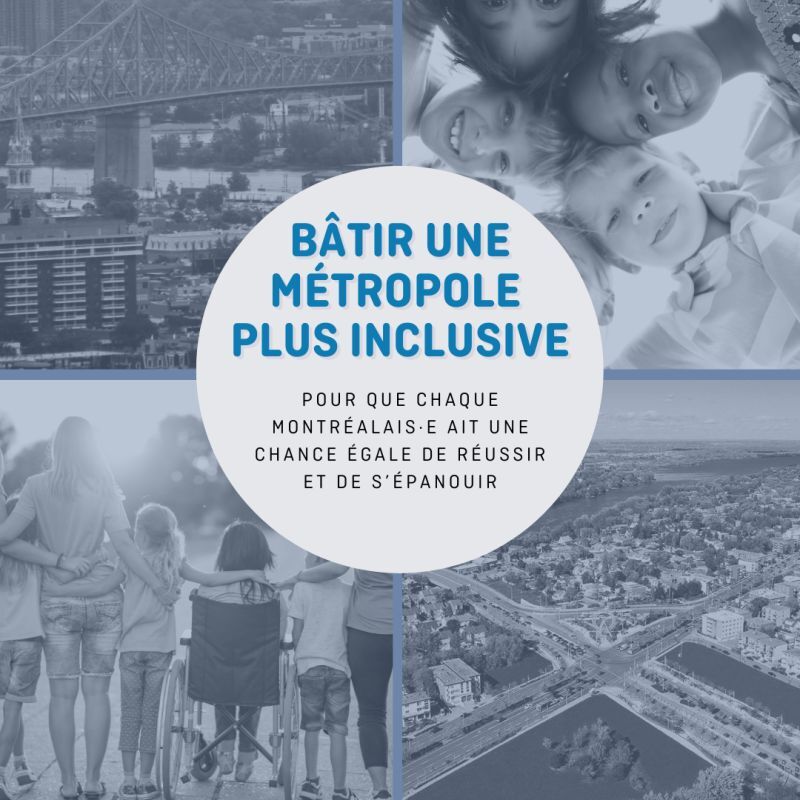
On October 6, in Montréal-Nord, we were invited by the City of Montréal to the launch of the Inclusive and Resilient Neighborhoods (QIR) initiative and the new Living Environment Equity Index. Elected officials and professionals from various City departments and boroughs, neighborhood roundtables, community organizations, and journalists gathered to learn about and celebrate this new initiative, which aims to address historical and current territorial inequities and increase the effectiveness of the City of Montreal’s interventions by prioritizing living environments that face multiple vulnerabilities.
A few days later, Valérie Plante told us that:
The new Inclusive and Resilient Neighborhoods (QIR) approach uses data science and the expertise of local communities to identify needs in the most vulnerable neighborhoods. The first three neighborhoods that will receive special attention are:
- The Sainte-Marie neighborhood (Centre-Sud), inthe Ville-Marie Borough – City of Montreal
- The Northeast of the Montréal-Nord Borough
- The St-Pierre neighborhood, in the Lachine Borough
These less affluent neighborhoods have more heat islands and more limited access to green spaces, parks, and sports and recreational facilities. These neighborhoods are undergoing rapid transformation and are home to committed residents who want to improve their quality of life.
The Montreal Coalition of Neighborhood Councils was also present and shared a few photos of the launch event with us:
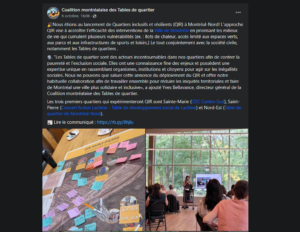
We would like to echo the words of Yves Bellavance in welcoming this announcement regarding the rollout of the QIR and offer our collaboration so that we can work together to reduce regional inequities and make Montreal a more united and inclusive city.
Read the press release below and here.
MONTREAL, the Oct. 6 2023 /CNW/ – Working tirelessly to provide welcoming and safe living environments for its residents, the City of Montreal today unveiled its new approach aimed at reducing inequities in the city’s most vulnerable neighborhoods: the Inclusive and Resilient Neighborhoods (QIR). This initiative relies on stakeholders on the ground to identify needs in order to better address the challenges facing neighborhoods with multiple vulnerabilities.
To begin with, the City has set a goal of bringing about sustainable improvements in three Montreal neighborhoods: Saint-Pierre in the Lachine borough, Sainte-Marie in the Ville-Marie borough, and the northeastern part of the Montréal-Nord borough. These three neighborhoods were selected in part following an assessment of the level of deprivation in the area, made possible by the Living Environment Equity Index.
The QIR approach aims to increase the effectiveness of municipal interventions by prioritizing neighborhoods that face multiple vulnerabilities, including the presence of heat islands, as well as limited access to green spaces, parks, and sports and recreation facilities. These areas are also targeted because of their potential to mobilize the community and because they are neighborhoods undergoing transformation. Through this new approach, the City hopes to engage civil society in the development of new living environments to prevent the gentrification of these neighborhoods in transition and the forced displacement of vulnerable populations.
In practical terms, this will take the form of infrastructure projects, development initiatives, and improvements aimed at enhancing the quality of life for residents in these areas. These projects will be implemented through a governance model that promotes a bottom-up approach, bringing together neighborhood councils and local community stakeholders, central government services, and the relevant borough. Ultimately, the City aims to expand this approach to all boroughs.
“Our administration has made territorial equity a top priority since taking office. For us, it’s more than just a slogan—it’s a genuine commitment—and, once again, we’re turning words into action. With the launch of the Living Environment Equity Index and the Inclusive and Resilient Neighborhoods (QIR) approach, the City is equipping itself with new strategic tools to better prioritize its investments in Montreal’s most vulnerable neighborhoods. “Our goal is to provide the same quality of life and the same services to all Montrealers, regardless of their neighbourhood. To achieve this, we must rely on data and the expertise of local stakeholders,” said Dominique Ollivier, Chair of the City of Montreal’s Executive Committee and responsible for finance, human resources, government relations, the fight against racism and systemic discrimination, and the French language.
“I am particularly proud of what we are announcing today. For me, this represents a concrete step forward in our Montréal 2030 vision to address the challenges of today and tomorrow. These new initiatives will provide a response tailored to the needs of Montrealers. “With the rollout of the QIR and the Living Environment Equity Index, Montréal is equipping itself with new tools to transform the city and its most vulnerable neighbourhoods,” said Nadia Bastien, Acting Deputy Director General—Quality of Life.
“Neighborhood Councils play a vital role in our neighborhoods in combating poverty and social exclusion. They have in-depth knowledge of the issues and possess unique expertise in bringing together organizations, institutions, and citizens to address social inequalities. We wholeheartedly welcome this announcement regarding the rollout of the QIR and offer our continued collaboration so that we can work together to reduce regional inequities and make Montreal a more united and inclusive city,” added Yves Bellavance, Executive Director of the Montreal Coalition of Neighborhood Councils.
The Living Environments Equity Index is a territorial index designed to identify living environments with multiple urban vulnerabilities in order to support the prioritization and alignment of municipal investments. The index helps establish a shared understanding of the multidimensional vulnerabilities present in the region.
“We are pleased to have collaborated with the City of Montreal on the creation of the Living Environment Equity Index. This initiative reflects our shared commitment to building a city where equity is at the heart of every neighborhood. Together, we are working to ensure that every resident can live in an environment that promotes their well-being and health,” concluded Dr. Mylène Drouin, Montreal’s Regional Director of Public Health.
To view the Living Environment Equity Index, click here.
SOURCE Ville de Montréal – Office of the Mayor and Executive Committee
For more information: Source: Marikym Gaudreault, Press Secretary to the Executive Committee, Office of the Mayor and the Executive Committee, 438-925-0884; For more information: Media Relations Department, City of Montreal, relationsmedias@montreal.ca