
Official Launch of the Transition en Commun Alliance
[PRESS RELEASE] On the Road to COP 15 — Montreal Joins Forces with Transition en Commun, a Citizen Alliance for Ecological Transition
Source: Newswire
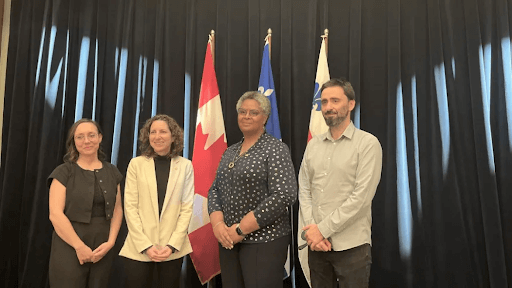
MONTRÉAL, November 15th 2022 – Montreal is proud to partner with Transition en Commun, an alliance between the City, its residents, and civil society organizations. The collaborative approach to building this partnership aims to implement an ambitious vision for socio-ecological transition that is rooted in the neighbourhoods. The first official meeting of the steering committee, co-chaired by Dominique Ollivier, Chair of the City of Montreal’s Executive Committee, Marie-Andrée Mauger, Executive Committee member responsible for ecological transition and the environment, and Bertrand Fouss, co-founder of Solon Collectif.s, took place today at Montreal City Hall.
Transition en Commun emerges from a strong mobilization of civil society. This alliance directly supports the City’s objectives as part of the 2020-2030 Climate Plan to ensure the territory’s adaptation to climate change and carbon neutrality by 2050. This partnership also meets an important objective for mobilization in the context of the next COP 15, which will take place in December in Montreal. This citizen initiative emanates, in particular, from the Citizen Projects working group of the Montreal Climate Partnership, supported by the City of Montreal, to mobilize key civil society players in achieving the objectives of its 2020-2030 Climate Plan.
The approach has gradually established itself as an essential complementary solution to catalyze the citizen forces present and increase their impact. Based on the common vision developed at the first official meeting of the steering committee, it will work to define and implement a common action plan to transform the living environments of Montreal’s neighbourhoods.
Citations
“The climate emergency is one of the greatest challenges facing our society. It also presents an opportunity to rethink the way we live and build our city to make it more resilient, inclusive, prosperous, and livable. The City of Montreal’s participation in Transition en Commun demonstrates our commitment to examining—and, where necessary, transforming—our practices in order to maximize the impact of citizen participation on the ecological transition. I am proud of this forward-thinking initiative, which brings citizens together in the fight against climate change and the implementation of solutions. Emerging from the Montréal Climate Partnership, this initiative also aligns with the objectives of COP 15, which will be held in Montréal in December and aims, in particular, to involve local communities in safeguarding biodiversity and advancing the socio-ecological transition. ” — Valérie Plante, Mayor of Montreal.
“The ecological transition is at the heart of everything we do at the City of Montreal. However, for this priority to become a true societal initiative, we need much greater, more diverse, and more effective participation from citizens and organizations across the city—and this must happen at the neighborhood level. This social innovation project will build social capital among citizens and civil society by increasing the autonomy of local communities, expanding opportunities for collaboration, and accelerating the scaling up of solutions. ” — Marie-Andrée Mauger, Head of the Environment and Ecological Transition.
“To achieve our socio-ecological transition goals, we must make this a societal project. To do so, we need to build alliances and rethink our approaches, here in Montreal. That is what Transition en Commun proposes: working together—whether with citizen groups, community organizations, cultural institutions, research institutions, public health agencies, or the social economy—in every neighborhood, to build new narratives and develop ambitious, inspiring solutions alongside our residents. The City’s commitment to this initiative at the highest level allows us to solidify our ambitions and explore a range of new avenues.” — Bertrand Fouss, co-chair of the steering committee and co-founder of Solon Collectif.s.
“The partners of Transition en Commun are united by a shared vision: that of a socio-ecological transition that takes social inequalities into account. By working at the neighborhood level, TeC aims to ensure that environmental initiatives are aligned with the needs and realities of different communities, particularly the most vulnerable. This approach will be supported by consultation and collective action structures deeply rooted in their communities—the neighborhood roundtables. Building a city that is both more eco-friendly and more inclusive is a challenge that requires a genuine commitment from our institutions and exemplary collaboration with communities. ” — Joakim Lemieux, Community Life Coordinator at the CMTQ.
“Since its inception, the Montreal Climate Partnership (PCM) has recognized the essential and distinctive role of citizens, as well as Montreal’s social and community fabric, in addressing the climate challenges we are already facing—and which will intensify in the coming years. I am delighted that the leadership and collaboration of the organizations and citizen groups involved in the PCM have led to a mobilization initiative as strong and unifying as Transition en Commun, which is rooted in Montreal’s neighbourhoods. This initiative will complement perfectly the other mobilization activities of the Montreal Climate Partnership, which are aimed more specifically at the economic, institutional, and philanthropic sectors. We believe in the power of collective action; we live by it, and we look forward to supporting and contributing to Transition en Commun so that we can collectively achieve the City of Montreal’s climate targets.” — Mélanie Le Berre, Executive Director of the Montreal Climate Partnership.
“We are facing multiple contemporary crises—the COVID-19 pandemic, climate change, the housing shortage, homelessness, the overdose epidemic, and social isolation—which compound historical injustices and inequities. The socio-ecological transition requires us to transform the ways we work together, to engage with a diversity of knowledge and expertise, and to develop visions of the future that bring people together and promote health and well-being for the entire population. ” — Dr. Mylène Drouin, Regional Director of Public Health for the Montreal region.
SOURCE: City of Montreal – Office of the Mayor and the Executive Committee
For more information:
Marikym Gaudreault, Executive Committee Press Officer, 514 925-0884, marikym.gaudreault@montreal.ca
Media Relations, City of Montreal, relationsmedias@montreal.ca