Félissa Lareau Carpentier
Arrondissement de Montréal-Nord

What if we acknowledged the common roots of social inequality and the climate crisis?
Environmental justice places the people and communities most vulnerable to these injustices at the heart of the socio-ecological transition: it affirms their dignity and strengthens their capacity to take action, without imposing new burdens on them. A just transition is collective, based on solidarity, and decolonial, and holds institutions—particularly municipal ones—politically accountable for transforming their policies and practices.
Arrondissement de Montréal-Nord
Indépendante | Aile jeunesse du Chantier de l'économie sociale
Direction régionale de santé publique de Montréal
Coalition montréalaises des Tables de quartier (CMTQ)
Labo Équité Climat, INRS
Chaire de recherche sur la réduction des inégalités sociales de santé (Chaire RISS), UQAM
SDIS, Ville de Montréal
Éclore
Tshuapamitin
HUB de mobilisation pour la justice climatique
Hoodstock
Multitudes
Observatoire pour la justice migrante
Front commun pour la transition énergétique
UQAM & Ligue des Droits et Libertés
Front commun pour la transition énergétique
Ville de Montréal - Bureau des commissaires
Centre québécois du droit en environnement
Harambec
UQAR
Conseil interculturel de Montréal
Conseil interculturel de Montréal
CMTQ
Espace pour la vie
Table de quartier Hochelaga-Maisonneuve
Ligue des droits et libertés
Indépendante
Observatoire québécois des inégalités
Ville de Montréal - Commissaire à la lutte contre le racisme et les discriminations systémiques
Table ronde du quartier chinois
Université d'Ottawa
Maison Turquoise
Solidarité Mercier Est
Montréal Autochtone
Ville de Montréal - Commissaires aux relations avec les peuples autochtones
RAPSIM
Ville de Montréal - SDIS
Mikana
Indépendant
INRS
McGill, Département de sciences politiques
Developed in the wake of the Mikana x TEC training programs—which ran for over two years and attracted more than 1,000 registrants—the Environmental Justice Track is a flexible schedule of activities and content that creates opportunities to learn, share knowledge, and address various environmental justice issues. Participatory workshops, conferences, field visits, and sharing of real-life experiences—all organized into four thematic seasons to move beyond common misconceptions about issues linking social and environmental justice.
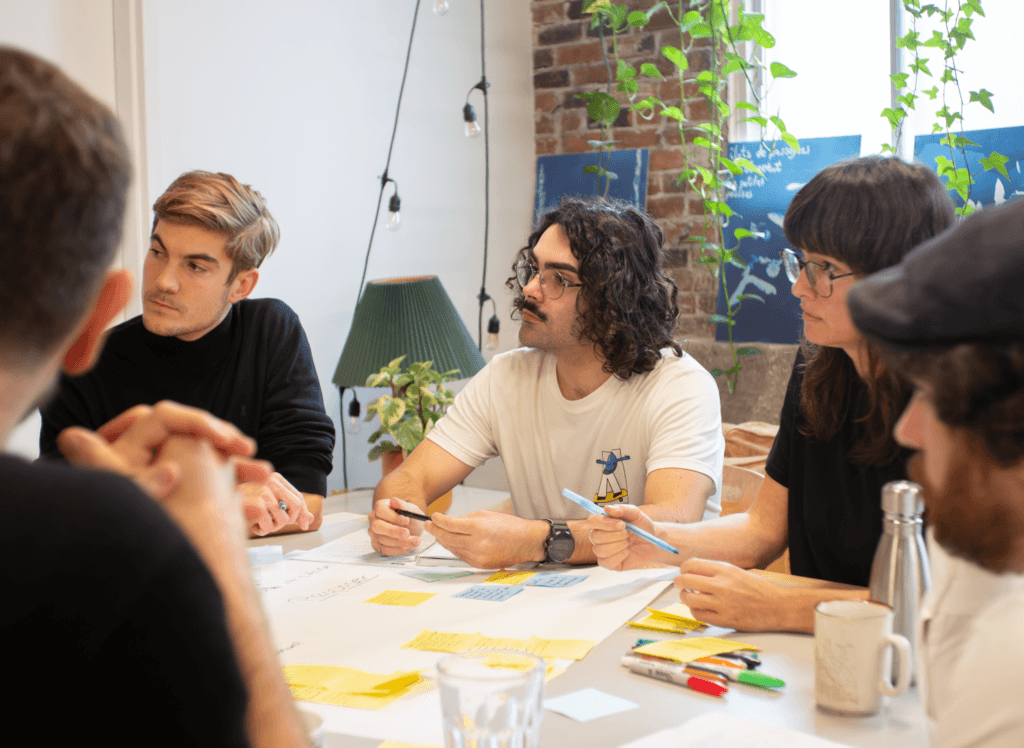
Offered to “Transition en commun” groups, the clinics are one-time spaces for applied co-development where, based on concrete actions and with the aim of supporting those actions, participants generate transferable insights and (re)orient collective practices.
As part of its collaboration with Mikana, Transition en Commun offered more than 300 participants the opportunity to learn more about the histories and perspectives of Indigenous peoples. The rationale? Raising awareness among non-Indigenous people about the realities faced by Indigenous peoples is seen as a way to foster understanding and genuine dialogue. The goal? To gradually dismantle the systemic racism and colonialism that still permeate our institutions and societal projects.
