Verdun Welcomes the Alliance for Its 8th Neighborhood Visit!
On October 2, several organizations hosted members of the alliance to present the unique characteristics of the borough and explore its challenges related to social diversity, gentrification, civic engagement, urban planning, culture, and the economy. Bringing together residents, elected officials, and local stakeholders, the tour allowed participants to explore iconic sites in Verdun, learn more about the profound transformations the borough is currently undergoing, and experience the love for this corner of Montreal firsthand from the very best ambassadors one could ask for.
Tour starts at 1:15 p.m. at the Marcel-Giroux Community Center
Following welcoming remarks by Francis Waddell (Demain Verdun) and the tour’s organizing committee, it was the turn of Marie-Andrée Mauger, mayor of Verdun and co-chair of TeC, to speak. She described Verdun as a neighborhood in the midst of major change, with a growing population and an influx of visitors drawn to the river. While this may seem like a positive development, the mayor nevertheless highlighted an undeniable “crisis of vulnerabilities,” exacerbated by the pressures placed on the most vulnerable residents.
Julien Caffin, from the Verdun Neighborhood Roundtable—Concertation en Développement Social de Verdun (CDSV)—then presented a nuanced overview of the borough, which is made up of three neighborhoods with very distinct realities.
He emphasized that behind Verdun’s vibrant image lie major challenges: in particular, many vulnerable people have been forced to leave their neighborhoods in recent years, while others are currently facing increasingly precarious living conditions.
The Environment: A Catalyst for Action
Following this general overview, various citizen-led initiatives were presented. Édouard Hippolyte, from the Maison de l’environnement, highlighted citizen projects such as tree-adoption programs, which strengthen a sense of community, while Vicky St-Pierre, Jean-François Bertrand, and Francis Waddell then presented urban agriculture initiatives, such as the Jardins de Max and the Jardins du Pacifique, which also enable vulnerable populations to get involved while fostering social connections. However, it was noted that administrative procedures remain complex and often act as a barrier to citizen engagement.
Urban Planning and Revitalization Projects
Around 2:00 p.m., the group then headed outside and made its first stop at the corner of the Verdun station, where Jean Cardin, head of the Technical Studies Division for the City of Montreal, provided details on the new layout of Verdun Street, a key thoroughfare in the neighborhood. Thanks to two bike lanes, this street now allows for smooth traffic flow for cyclists, with an impressive volume of 500 bicycles per hour. This project, implemented on a temporary basis, was adapted along the way, illustrating a flexible approach to urban planning.
The walk then took participants to the DBG Dawson Community Center, where educational, recreational, and preventive programs are offered to a priority English-speaking population.
At the Heart of Community and Business Issues
A little later, the Verdun Mutual Aid Network Food Bank also opened its doors to the participants, who were welcomed by Rudy. The organization, which operates with the help of volunteers, serves between 200 and 250 families every Monday. We received a warm welcome there despite a power outage on Wellington Street.
Davin Velly, of the Wellington Business Development Corporation (SDC), discussed the initiatives implemented to revitalize Wellington Street, such as making it a pedestrian-only zone. Although not all business owners are on board yet, this transformation has strong support from the community.
Another highlight was a visit to the green alleyway nicknamed “La petite RueWell,” a project led by Joliane and Alexandre, residents of Verdun. This one-of-a-kind community project transformed an alleyway into a community space connecting Wellington Street to the river. Challenges related to disputes between neighbors were addressed, but the importance of collective synergy in overcoming these tensions was emphasized.
Encouraging Civic Engagement
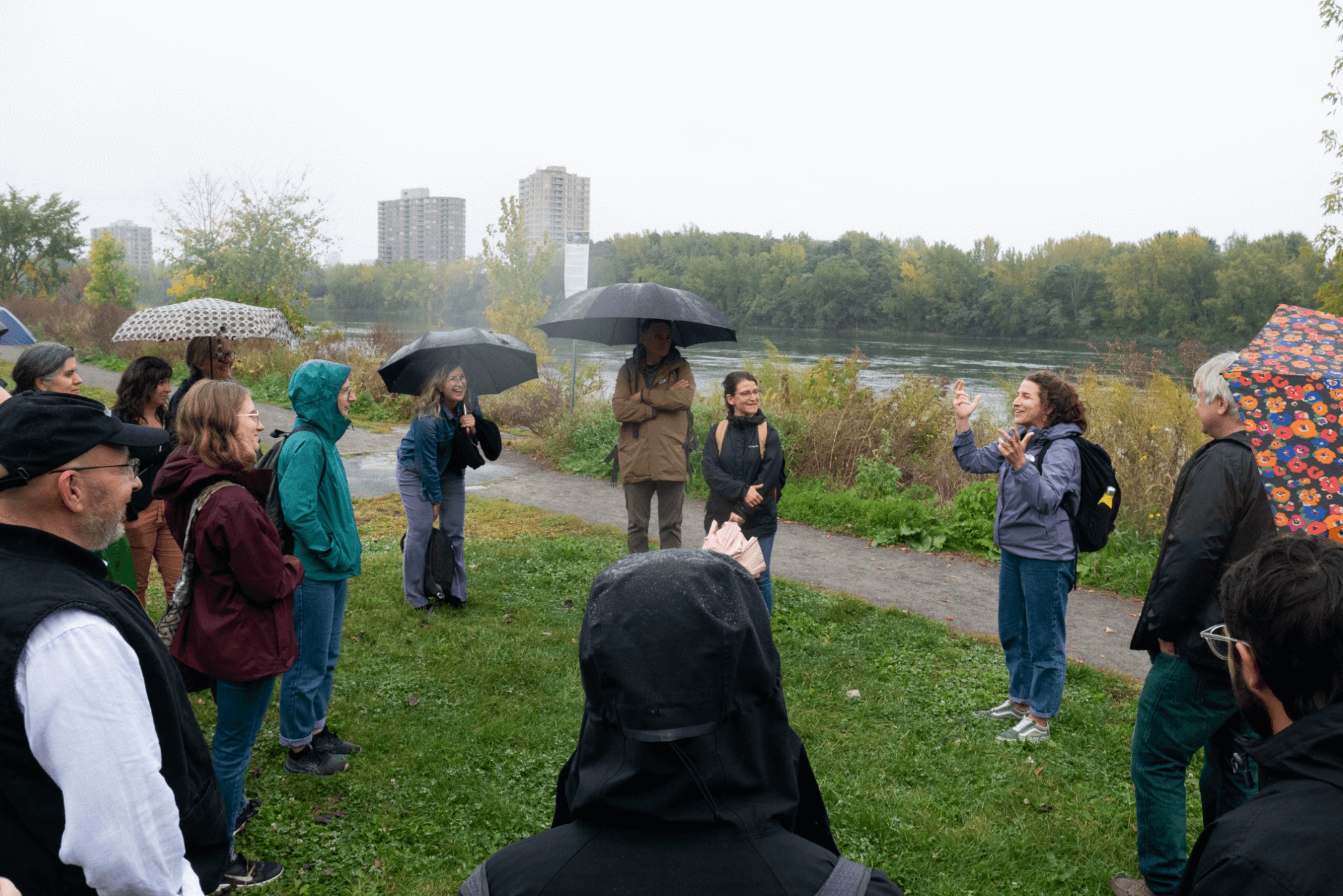
A final outdoor discussion by the river with Tania Konicheckis gave participants the opportunity to learn more about the activities of Demain Verdun, a local citizen-led movement that promotes local initiatives such as the Verdun-sur-Fleuve festival and mobilizes the community for social and ecological transition.

A Golden Happy Hour (literally)
Finally, participants visited Quai 5160—Verdun’s cultural center—where they were briefed on the commitments the organization had made to earn “Eco-Responsible Stage Gold” accreditation. On that optimistic note, a happy hour marked the end of a day of discussion and discovery, revealing a community in the midst of transformation but resolutely committed to preserving its identity and overcoming the challenges it faces. Verdun, straddling tradition and modernity, continues to write its story, driven by the strength of its residents.

A big thank you to everyone·to everyone who welcomed us, as well as to the participants·e·who braved the rain and the gray skies!
📸 For all the photos, click here!